
For centuries, a linen cloth known as the Shroud of Turin has been at the center of one of history’s greatest mysteries — believed by some to be the burial cloth of a crucified man. Scientists, historians, and believers have long debated its origin, meaning, and how its faint image was formed.
Recently, researchers used advanced artificial intelligence to examine ultra-high-resolution scans of the cloth in ways never done before. Instead of simply mapping the familiar image, the AI looked deep into the microscopic structure of the fabric.
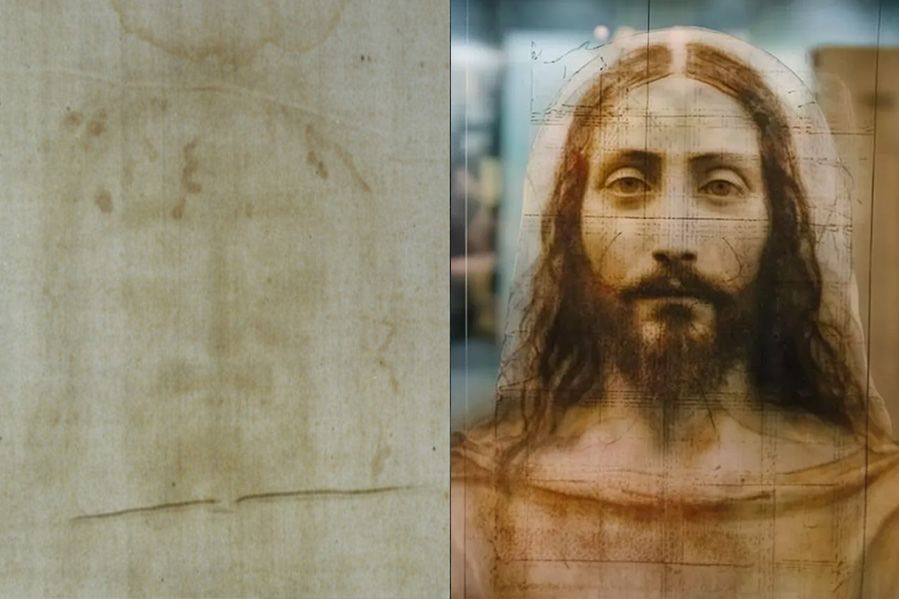
What it found was unexpected: complex mathematical and geometric patterns woven into the fibers across the entire piece of cloth. These patterns weren’t random — they showed strong internal consistency, repeating proportions, mirrored alignments, and fractal-like sequences that appeared even when sections of the cloth were rotated or magnified.
The discovery surprised experts because:
- The structures didn’t resemble artistic decorations or familiar textile patterns.
- The geometry appeared embedded in the cloth, not just on the surface.
- The patterns seemed to align with anatomical features of the image in ways that suggested simultaneous formation.
According to researchers involved, no known medieval technique — artistic, chemical, or mechanical — could produce this kind of mathematical order in fabric that was meant to be a simple burial cloth. Some analysts described the patterns as resembling encoded information rather than accidental marks.
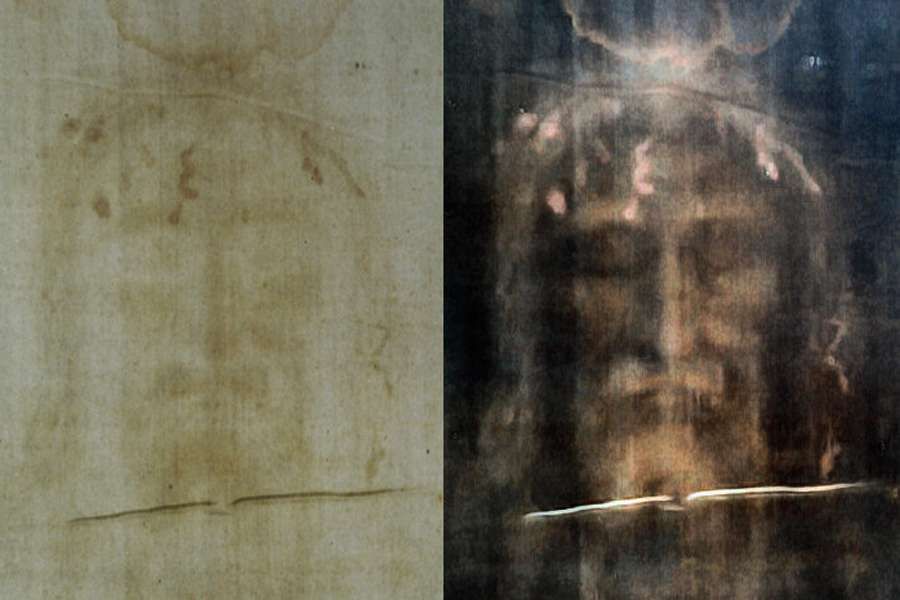
Because of this, the discovery has sparked debate across scientific, historical, and philosophical circles. Some see it as a sign that the cloth may encode more than just a visual image — others urge caution, saying pattern-finding tools can sometimes identify structure where none was intentionally placed.
Whatever the explanation, this AI-driven analysis has added a new chapter to the mystery of the Shroud of Turin — one that blends history, technology, and human curiosity in a way few expected.
