
The courtroom was already tense when the judge’s gavel struck the bench. Lawyers shuffled papers, spectators whispered, and a young woman stood in handcuffs near the front—her eyes lowered, her future uncertain.
Then a child’s voice shattered the silence.
“Let my nanny go! I know what really happened!”
Every head turned.
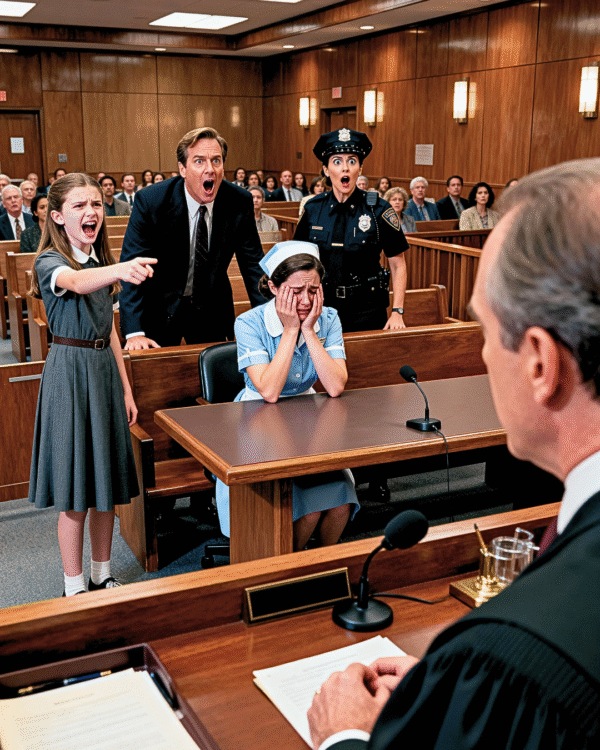
The nine-year-old girl in a red dress pushed forward, tears streaming down her face, her small hands trembling as she pointed toward the accused woman. The nanny looked up for the first time. The billionaire seated nearby avoided the child’s gaze. Even the judge froze.
No one had expected the truth to arrive like this.
A Job That Meant Survival
Sofía Ríos was twenty-seven, newly graduated in early childhood education, and living paycheck to paycheck in a cramped apartment she shared with two roommates. When she saw the listing for a live-in nanny, the salary felt unreal. It meant paying off her mother’s medical debts. It meant stability. It meant dignity.
She didn’t expect to be chosen.
Yet three days later, she stood outside a mansion in Lomas de Chapultepec, wearing the only blazer she owned—carefully stitched years earlier by her mother. The gates opened silently, and with them came the unmistakable feeling that she didn’t belong there.
She was hired in fifteen minutes.
The rules were clear: use the service entrance, don’t ask questions, and never get too close to the family. Her only responsibility was the child.
A Little Girl Who Knew Too Much
Elena Aguilar was nine years old, quiet, pale, and far too observant. When she first met Sofía, she didn’t smile.
“You’ll leave too,” the girl said simply. “They always do.”
That night, Sofía learned why.
A scream echoed through the hallway. Elena’s bedroom door was locked from the outside. Inside, the child was shaking in the closet, whispering one name again and again.
Marta.
Two Faces Behind Closed Doors
Marta Valdés, the billionaire’s wife, was flawless in public. Elegant, affectionate, admired. Online, she looked like the perfect stepmother.
Behind closed doors, she was something else entirely.
When Elena disobeyed, she went without meals. When she cried, she was locked away. Drawings of her late mother were torn apart. Words were chosen carefully—quiet, cutting, unforgettable.
Sofía didn’t confront her. She watched. She listened.
And she recorded everything.
A Father Who Didn’t Want to See
When Sofía tried to speak to Elena’s father, Mateo Aguilar, he brushed her off.
“Elena imagines things,” he said. “Marta helps her.”
But something had changed. Elena was eating again. Laughing. Sleeping through the night. Mateo noticed the difference but refused to question its cause.
Marta noticed too.
And she acted first.
A Setup That Nearly Worked
While Mateo was away on business, Marta hid jewelry in Sofía’s room. She locked Elena in the attic with snacks and a tablet. Then she called the police.
“The nanny kidnapped my stepdaughter,” she said.
Sofía was arrested at dawn, still in her pajamas.
The story spread fast. A poor nanny. A powerful family. A missing child.
Two days later, Elena was found alive.
“It was a game,” she told the police calmly.
Then she showed them her phone.
The Moment the Truth Spoke
At the trial, Marta’s lawyer attacked Sofía’s background, her education, her intentions. The case seemed sealed.
Then Elena stood up.
Dressed in red, voice shaking but steady, she raised her phone.
“Let my nanny go,” she said. “I know the truth.”
The video played.
The courtroom fell silent.
Cruel words. Locked doors. Punishments. Fear.
The lie collapsed in real time.
What Remained After the Verdict
Marta was convicted.
Sofía was freed.
Outside the courtroom, Mateo knelt in front of the woman he had doubted.
“I failed her,” he said.
Elena didn’t speak. She simply hugged Sofía.
“I knew you were good.”
A Life Changed, A Lesson Learned
Years later, Sofía founded a support center for domestic workers—women whose voices were often ignored until it was too late. Mateo restructured his company, committing resources to child welfare and accountability.
On the wall of the center hangs a framed headline:
“Let My Nanny Go. I Know the Truth.”
It isn’t a reminder of wealth or power.
It’s a reminder that truth doesn’t always arrive from the strongest voice in the room—sometimes, it comes from the bravest.
